
In today’s industrialized world, the precision control of temperature and humidity isn’t just a comfort – it’s a necessity. From pharmaceutical manufacturing and data centers to food processing plants and large commercial complexes, maintaining optimal thermal conditions is critical for operational efficiency, product integrity, and even safety. At the heart of this crucial function are industrial chillers, the unsung heroes of modern climate control.
For facility managers and engineers, understanding the nuances of chiller technology – particularly the distinction between air-cooled and water-cooled systems – is paramount. The right choice can significantly impact energy consumption, maintenance costs, and overall system performance.
Air-Cooled vs. Water-Cooled Chillers: A Critical Comparison
Let’s break down the fundamental differences and applications of these two primary chiller types:
1. Air-Cooled Chillers
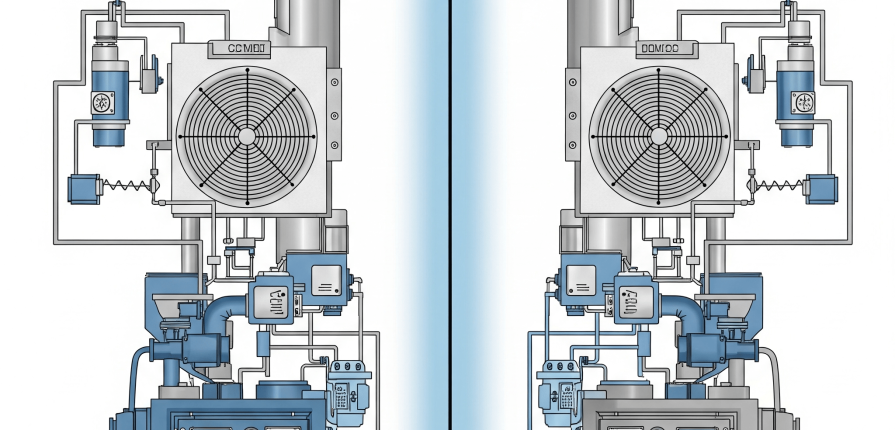
Air-cooled chillers reject heat directly into the ambient air. They typically consist of a compressor, a condenser (which uses fans to blow air over coils to dissipate heat), an expansion valve, and an evaporator.
Pros:
- Simpler Installation: No cooling tower or condenser water pump system is required, leading to a quicker and less complex setup.
- Lower Initial Cost: Generally, air-cooled units have a lower upfront cost compared to water-cooled systems of similar capacity.
- Reduced Water Usage: As they don’t rely on cooling towers, they consume significantly less water, which is a major advantage in regions with water scarcity or high water costs.
- Easier Maintenance: Fewer components mean simpler maintenance routines, avoiding issues like scaling and biological growth associated with cooling towers.
Cons:
- Lower Energy Efficiency (Generally): Their efficiency is highly dependent on ambient air temperature. On hot days, their performance can decrease, and energy consumption can rise.
- Larger Footprint: The condenser coils and fans require a substantial area, often on rooftops.
- Higher Noise Levels: The operation of large fans can generate considerable noise.
- Ideal Applications: Smaller to medium-sized facilities, commercial buildings, facilities where water conservation is a priority, or sites with limited space for cooling towers.
2. Water-Cooled Chillers
Water-cooled chillers reject heat to a water loop, which is then typically cooled by an external cooling tower. This system involves a compressor, a shell-and-tube condenser, an expansion valve, and an evaporator, along with the cooling tower and associated pumps.
Pros:
- Higher Energy Efficiency (Generally): Water is a more efficient medium for heat transfer than air. Water-cooled systems can achieve significantly higher Coefficient of Performance (COP) values, especially in larger capacities, leading to lower operating costs. A study by the U.S. Department of Energy often cites water-cooled systems as being 10-15% more efficient than air-cooled systems.
- Longer Lifespan: Operating at more stable temperatures can contribute to less wear and tear on components.
- Smaller Footprint (for the chiller unit itself): While they require a cooling tower, the chiller unit itself can be more compact and often installed indoors.
- Quieter Operation: The main chiller unit typically operates more quietly than an air-cooled equivalent, with most noise coming from the outdoor cooling tower.
Cons:
- Higher Initial Cost: The installation of a cooling tower, condenser water pumps, and associated piping adds to the upfront capital expenditure.
- Increased Water Consumption: Cooling towers lose water through evaporation, drift, and blowdown, leading to higher ongoing water usage.
- More Complex Maintenance: Cooling towers require regular chemical treatment and cleaning to prevent scaling, corrosion, and the growth of Legionella bacteria, which can be resource-intensive.
- Space Requirements: While the chiller can be indoors, the cooling tower requires significant outdoor space and specific siting considerations.
Ideal Applications: Large industrial facilities, hospitals, universities, large data centers, and any application where energy efficiency is the absolute top priority and significant cooling capacity is needed.
The Ozone Cool Advantage: Your Partner in Climate Control
Choosing the right chiller system is a complex decision that goes beyond initial cost. It involves a detailed analysis of your facility’s size, cooling load, climate conditions, water availability, energy costs, and long-term operational goals. Partnering with experts can prevent costly mistakes and ensure you invest in a solution that delivers optimal performance and energy savings for decades.
At Ozone Cool, we specialize in providing comprehensive HVAC solutions tailored to your unique needs. Our team of experienced engineers and facility management specialists offers:
Expert Consultation: Guiding you through the selection process for the most suitable chiller and Air Handling Unit (AHU) combination.
System Design & Integration: Ensuring your climate control system is perfectly sized and integrated for maximum efficiency.
Installation & Commissioning: Professional setup and testing to guarantee peak performance from day one.
Ongoing Support & Maintenance: Proactive maintenance programs to extend the life of your equipment and prevent costly downtime.
Did you know? The global industrial chiller market size was valued at USD 8.7 billion in 2022 and is projected to reach USD 11.8 billion by 2030, growing at a CAGR of 3.9% – a testament to the essential role these technologies play in industrial processes worldwide. (Source: Grand View Research).
Don’t let inefficient climate control compromise your operations or inflate your utility bills. Connect with our team at Ozone Cool today to discuss your facility’s specific challenges and discover how our expertise can optimize your industrial climate control strategy.
Recent Comments